Understanding how does the China-Vietnam border trade logistics work requires more than tracking trucks across a checkpoint. It involves customs declarations, cargo inspections, transport coordination, warehousing, payment documents, and changing import requirements. At ports such as Hữu Nghị–Youyi Pass and Móng Cái–Dongxing, a shipment may move through several controlled stages. Each stage affects delivery time, cost, and product quality.
Martin Christopher, a respected logistics and supply chain authority, explains, “Logistics is the process of strategically managing the procurement, movement and storage of materials, parts and finished inventory.” This principle applies clearly to China-Vietnam trade. Reliable operators connect suppliers, customs brokers, carriers, border warehouses, and final buyers. They also verify certificates, product descriptions, packaging standards, and transport conditions before cargo arrives.
Small errors matter.
A missing document can delay a truck. Poor temperature control can damage fresh produce. Unclear responsibility can create unexpected storage charges. These problems show why efficient border logistics depends on preparation, communication, and legal compliance. However, no single method works for every shipment. Seasonal demand, weather, border congestion, and policy adjustments can change the best route quickly. This guide examines seven practical ways to improve cross-border movement, including multimodal transport, digital documentation, bonded warehousing, and stronger customs coordination. It also reflects on common weaknesses, because real logistics systems are rarely perfect. Reliable performance comes from measuring delays, learning from mistakes, and improving each handover.
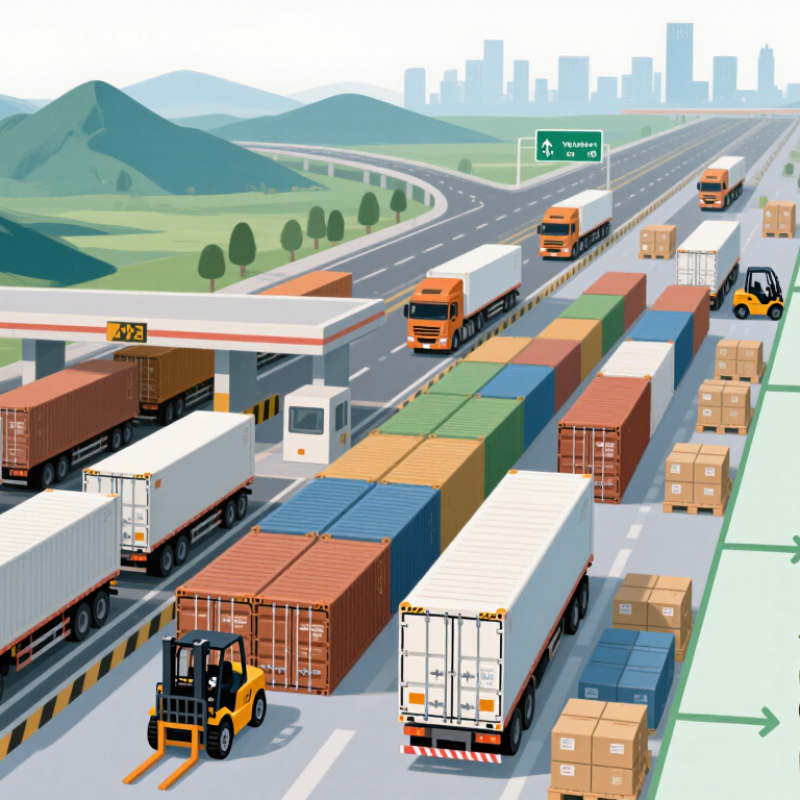
China–Vietnam border logistics becomes clearer when viewed through the US$171.9 billion trade flow recorded by Vietnam Customs in 2023. This figure covers diverse products, routes, and declarations. It also shows why reliable movement requires more than a truck and a border gate.
Seven practical methods shape this flow. Traders select routes by cargo type, border capacity, and seasonal congestion. They prepare accurate invoices, packing lists, permits, and transport records before departure. Correct HS classification reduces delays. It is not merely paperwork. Pre-clearance checks allow brokers and carriers to identify missing information earlier. Consolidating compatible shipments can reduce handling costs, while temperature-controlled equipment protects sensitive cargo. Small timing buffers matter during holidays and inspection peaks.
Visibility improves when each shipment receives milestone tracking from warehouse loading to customs release. Inventory teams should keep safety stock near major distribution points, but not overbuild it. That balance remains difficult. Customs rules and local procedures can change, so experienced operators verify requirements through official sources and licensed professionals. Vietnam Customs statistics provide an authoritative reference, yet trade values may differ by reporting method, valuation, or product category. In practice, a simple document error can disrupt an otherwise efficient route. Reflection is necessary. Every shipment should record delays, inspection causes, and corrective actions for the next movement.
China–Vietnam border logistics works best when cargo matches the gate. The nine main corridors differ sharply in capacity, route, and delay exposure. Huu Nghi handles heavy road flows on the Nanning–Hanoi route. Lao Cai supports road and rail links toward Kunming. Mong Cai connects northeastern Vietnam with southern China and nearby coastal routes. These are usually stronger choices for regular, high-volume shipments.
Tan Thanh and Chi Ma suit selected agricultural and light industrial cargo, but waiting times can rise during harvest seasons. Ta Lung and Tra Linh provide useful links toward Guangxi, although their operating capacity is generally smaller. Thanh Thuy offers access toward Yunnan, with longer inland routing and fewer backup options. The Dong Dang rail corridor can reduce highway pressure, yet schedules and wagon availability require careful checking.
Transit risk is not only distance. Border inspections, weather, road congestion, packaging quality, and missing documents can change delivery times quickly. Experienced forwarders compare queue records, customs hours, truck availability, and cold-chain needs before booking. A practical plan may split cargo between Huu Nghi and Lao Cai. That reduces dependence on one crossing. Still, this comparison is not permanent. Capacity changes with construction, seasonal demand, and local controls. Any route promise without recent operating data deserves caution.
The comparison uses nine established road crossings. Capacity is a relative operational index based on infrastructure and freight-handling scale; route score reflects road proximity to Hanoi; transit-risk exposure combines congestion, weather, road conditions, and customs complexity. Higher is better for capacity and route score, while higher risk exposure indicates greater uncertainty.
Gate names follow commonly used China–Vietnam crossing names. Road distances and index values are indicative planning benchmarks rather than official customs capacity statistics.
For China–Vietnam border trade, customs documents should begin with the correct HS code, not the invoice template. The World Customs Organization states that the Harmonized System is used by more than 200 countries and economies. A wrong six-digit classification can distort duty rates, origin calculations, and inspection risk. Check the product’s material, function, processing method, and packaging separately. Keep product photos and technical sheets beside the classification decision.
RCEP matters because regional cumulation may allow materials from member economies to count toward origin requirements. The RCEP Secretariat reports that its members represent about 30% of global GDP and roughly 28% of world trade. However, preference is not automatic. Compare the product-specific rule with the tariff schedule, then prepare the required proof of origin. Record supplier declarations, production locations, and the value calculation in one file. Border officers need a clear trail, not a confident explanation.
A practical shipment file should match the commercial invoice, packing list, transport document, origin statement, and customs declaration line by line. Use the same product description and quantity units. Small mismatches cause real delays. In my experience, teams often copy last month’s HS code without reviewing a changed component. That shortcut is risky. The 2023 World Bank Logistics Performance Index also shows that customs efficiency remains uneven across trading routes, so document quality still matters. Recheck classifications when a product design, supplier, or RCEP rule changes. Mistakes happen. The process should make them visible early.
7 Best Ways China Vietnam Border Trade Logistics Work?
Combining road, rail, and cold-chain logistics can improve product-specific efficiency at the China-Vietnam border. Road transport offers flexible pickup near factories and markets. It suits urgent, smaller shipments and short border distances. Rail can carry heavier volumes with steadier schedules. However, gauge differences and border transloading may reduce its advantage. The World Bank’s Logistics Performance Index 2023 rated China at 3.7 and Vietnam at 3.3, showing room for better coordination.
Product condition should guide the transport plan. Fresh vegetables need pre-cooling, insulated loading, and continuous temperature records. For many leafy products, 2–8°C may work, but specifications must be checked by product. FAO reported that about 14% of global food is lost between harvest and retail. A delayed inspection can turn a full truck into a costly waste problem. Use road transport for the first and final miles, rail for stable bulk movement, and refrigerated vehicles for sensitive cargo. Keep backup power available at transfer points.
A mixed route is not automatically better. It needs real testing. I would compare border dwell time, damage rates, temperature excursions, and handling costs for each product category. Dry goods may tolerate rail transfers. Fresh fruit may not. Data loggers, bilingual documents, and pre-booked inspection windows reduce avoidable friction, although paperwork errors still happen. That weakness deserves honest review.
| No. | Logistics Method | Typical Border Corridor | Best-Suited Products | Typical Transit Planning Range* | Temperature or Load Requirement | Main Efficiency Advantage | Key Control Point |
|---|---|---|---|---|---|---|---|
| 1 | Direct cross-border road freight | Southern China production areas to Pingxiang–Dong Dang or other approved road crossings | Electronics, garments, machinery parts, packaged consumer goods | 1–3 days after dispatch | Dry cargo; standard or sealed trailer | Flexible door-to-door delivery with frequent departures and easy shipment consolidation | Pre-clear documents and confirm vehicle, cargo, and crossing eligibility before loading |
| 2 | Dedicated road reefer service | China origin warehouse to northern Vietnam distribution centers through an approved land crossing | Fresh fruit, vegetables, dairy products, chilled meat, and other perishables | 1–3 days, subject to border queues | Usually chilled 0–8°C or frozen at −18°C; continuous temperature monitoring | Fastest practical option for products with short shelf life and high temperature sensitivity | Use pre-cooling, calibrated data loggers, sanitary packaging, and controlled border transfer |
| 3 | Rail trunk haul plus road delivery | Rail freight through the Pingxiang–Dong Dang or Hekou–Lao Cai gateway, followed by local trucking | Textiles, industrial materials, machinery, durable consumer goods, and palletized cargo | 3–7 days, depending on rail and border handling | Dry, palletized, containerized, or breakbulk cargo | Reduces long-haul road mileage and can improve cost stability for regular base-load volumes | Confirm rail timetable, gauge or transshipment requirements, wagon availability, and final-mile capacity |
| 4 | Road feeder plus rail line-haul | Factory pickup by road, rail movement toward the border, then road delivery in Vietnam | High-volume non-perishables with predictable weekly demand | 4–8 days | Containerized or palletized dry cargo; moderate handling sensitivity | Balances factory access, rail economics, and flexible final-mile distribution | Schedule pickup cut-offs and allow buffer time for rail interchange and border inspection |
| 5 | Cold-chain cross-docking at the border | Reefer truck to a temperature-controlled border facility, then a second reefer for Vietnam delivery | Fresh produce, seafood, chilled foods, pharmaceuticals, and temperature-sensitive ingredients | 1–4 days, depending on inspection and transfer time | Temperature maintained during unloading, inspection, staging, and reloading | Allows vehicle changes while preserving product temperature and improving destination-market flexibility | Verify cold-room capacity, power backup, sanitation procedures, and maximum dwell time |
| 6 | Rail or road trunk haul with reefer last mile | Temperature-controlled origin movement to a border or inland hub, followed by reefer distribution | Frozen foods, processed foods, longer-life chilled products, and consolidated cold cargo | 3–8 days, subject to equipment availability | Frozen cargo generally at −18°C or below; chilled cargo commonly 0–8°C | Combines lower trunk-haul intensity with specialized final delivery to wholesalers or retailers | Use validated packaging, temperature records, backup power, and contingency reefer capacity |
| 7 | Hybrid seasonal allocation | Road for urgent or perishable orders; rail for planned base-load shipments | Mixed portfolios such as electronics plus seasonal produce or food ingredients | 1–8 days by product and mode | Separate dry, chilled, and frozen operating lanes | Maintains service reliability during harvest peaks, holidays, border congestion, or demand surges | Set mode-switch rules using shelf life, order priority, inventory cost, and border congestion data |
China-Vietnam border trade logistics becomes measurable when operations rely on clear, repeatable indicators.
Dwell time shows how long cargo waits at terminals, inspection areas, and transfer points.
Record arrival, clearance, loading, and departure timestamps.
A shipment waiting beside a warehouse for nine hours needs attention, even if delivery remains on schedule.
Cost measurement should include transport, handling, storage, documentation, and unexpected rework.
Compare cost per shipment and cost per kilogram across different routes.
Pre-check customs documents, reserve loading slots, and consolidate compatible cargo.
These actions can reduce idle time. They do not always reduce total cost.
Our first estimate ignored weekend storage charges, which made the route look cheaper than it was.
Damage rates need photographs at handover points, especially around pallets, cartons, and moisture-sensitive goods.
Use sealed packaging, careful stacking, and short transfer distances where practical.
Delivery performance should track both on-time percentage and actual transit hours.
A shipment arriving one day late may still hide several small delays.
Review late cases by border crossing, carrier, weather, and loading shift.
Measure exceptions honestly. Improve the process, not just the report.
Vietnam Customs reported a trade flow valued at US$171.9 billion in 2023. It covered many products, routes, and declarations. The figure is a reference, not a complete operating forecast.
Match the crossing with cargo type, capacity, season, and transport needs. Huu Nghi suits heavy road flows. Lao Cai supports road and rail options. Route conditions can change.
Tan Thanh and Chi Ma can support selected agricultural cargo. Harvest periods may create longer queues. Protect products from heat, moisture, and rough handling. A backup route is useful.
Prepare accurate invoices, packing lists, permits, and transport records. Check HS classifications carefully. A small description error can delay clearance. Paperwork matters more than expected.
Use pre-clearance checks before trucks leave the warehouse. Confirm customs requirements through official sources and licensed professionals. Reserve loading slots when possible. Do not assume every delay is avoidable.
Use temperature-controlled equipment and suitable packaging. Record handover times and storage conditions. Inspect cartons for moisture or crushing. Cold-chain planning is imperfect sometimes.
Track dwell time, total cost, damage rate, and delivery performance. Record arrival, inspection, clearance, loading, and departure times. Compare costs per shipment and per kilogram. Numbers can expose hidden delays.
Keep practical timing buffers during holidays and inspection peaks. Split cargo between suitable crossings when possible. Maintain reasonable safety stock near distribution points. Too much inventory is also a problem.
Record the crossing, carrier, weather, loading shift, and inspection cause. Photograph pallets and cartons at handover points. Document corrective actions for the next shipment. Our first estimate may be wrong.
This guide explains how does the China-Vietnam border trade logistics work by examining the US$171.9 billion trade flow reported for 2023 and showing how cargo moves through major land crossings. It compares nine border gates according to handling capacity, transport routes, congestion exposure, and transit risks, helping traders select practical options for different shipment sizes and delivery schedules.
The article also explains how to organize customs documents under RCEP requirements, maintain accurate HS-code classification, and reduce clearance delays. It presents a product-specific logistics strategy that combines road transport, rail services, and cold-chain handling where appropriate. Finally, it recommends measuring performance through border dwell time, total logistics cost, cargo damage rate, and on-time delivery, allowing companies to identify bottlenecks, improve planning, and build a more reliable cross-border supply chain.
RLL Logistics